
Ingredients
- 2.5 oz Benedictine Herbal Liqueur
- .5 oz White Creme De Menthe
Instructions
Combine Ingredients:
- Pour 2.5 oz of Benedictine herbal liqueur and 0.5 oz of white crème de menthe into a mixing glass half-filled with ice cubes.
Stir Well:
- Stir the mixture well until it is thoroughly chilled.
Strain and Serve:
- Strain the mixture into a cocktail glass.
Enjoy:
- Serve immediately and enjoy your refreshing B and B Stinger.
Notes
Estimated Nutrition:
Where it came from
The Stinger itself has been around since the late 1800s, a classic digestif often made with brandy or cognac and crème de menthe. This B and B variation probably showed up when bartenders started playing with other rich, complex liqueurs as the base. No clean attribution for this specific twist, but it makes sense as a natural evolution.
Think of it as the Stinger's more herbal, slightly sweeter cousin. While a traditional Stinger uses a base spirit like brandy, this one leans fully into the liqueur. It’s a two-ingredient, stirred drink that delivers a serious flavor punch, proving that sometimes less really is more when the ingredients pull their weight.
You're not ordering this at brunch. This is your after-dinner drink, a serious nightcap when you want something potent and palate-cleansing. It's a conversation starter, sure, but mostly it's a quiet moment with a glass, letting the day's last sips do their work.
What it tastes like
First sip hits with Benedictine’s complex blend of honey, herbs, and spices, a deep, almost medicinal warmth. Then the white crème de menthe crashes in, a bright, chilling wave of peppermint that slices through the richness. It’s a bold contrast, a sweet and herbal hug followed by a crisp, cool slap.
Clocking in around 37.5% ABV, this drink is no joke. That's roughly seven to eight times stronger than your average beer. This isn't a session sipper you'll have multiples of, unless you plan on forgetting your name. One or two of these, and you're good for the night.
The technique
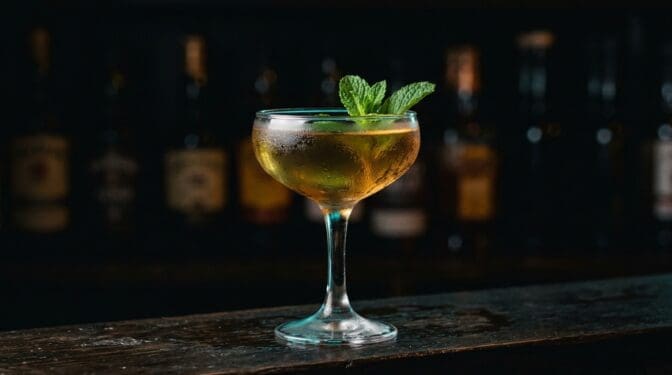
Building a B and B Stinger is straightforward. Grab a mixing glass, fill it halfway with ice, then pour in your Benedictine and crème de menthe. Give it a good, solid stir until the glass is frosty cold. Strain into a chilled cocktail glass, no garnish needed. Serve it quick before it loses its chill.
The secret here is the chill. Don't just give it a few lazy stirs. Really go for it. You want this drink ice cold to properly marry the rich herbal notes with the sharp mint. A warm B and B Stinger is a sad B and B Stinger.
Ingredient Spotlight
The bottles that make or break this drink.
Benedictine Herbal Liqueur
- Use
- The real deal, D.O.M. Benedictine. It's got that unique blend of 27 herbs and spices, honey, and a hint of citrus. Nothing else tastes quite like it.
- Skip
- Generic herbal liqueurs. They'll be too sweet, too thin, or just plain wrong. Don't try to fake this one.
- Why
- It's the backbone. Its complex sweetness and deep herbal character are what make this drink sing. Without it, you just have a minty cordial.
White Creme De Menthe
- Use
- A quality white crème de menthe, like Tempus Fugit or Bols. Clear is key here, to keep the drink’s appearance clean.
- Skip
- Green crème de menthe unless you want a Hulk-colored drink. Also, avoid anything too syrupy or artificial tasting.
- Why
- This is the 'sting'. It provides the sharp, refreshing mint counterpoint to Benedictine’s richness. It's the chill, the cut, the wake-up call.
Three Variations
Three real ways bartenders riff on this drink.
Classic Stinger
- The original minty digestif.
- Swap the Benedictine for 2.5 oz of good VSOP Cognac or brandy. Same minty kick, but with a drier, grape-based warmth.
Bourbon Stinger
- Mint meets barrel-aged bite.
- For a different kind of 'B', use 2.5 oz of a smooth bourbon instead of Benedictine. The vanilla and oak notes play nicely with the mint.
Dark Stinger
- A deeper hue, same cool bite.
- Use dark crème de menthe instead of white for a visually striking, deep green drink. The flavor profile remains similar, just a different look.
What if I don't have…
Quick substitutions for when the bottle shop is closed.
You're out of luck for a true B and B Stinger. It's a foundational ingredient. Try a different herbal liqueur like Chartreuse for an entirely different, but still potent, herbal drink.
Peppermint schnapps can work in a pinch for the mint kick, but it's usually sweeter and less complex. Adjust for sweetness if you go this route.
A pint glass or any sturdy, tall glass will do. Just make sure it can handle the ice and stirring.
A small coupe or even a rocks glass will serve. Just keep it chilled.
Frequently Asked Questions
Direct answers to what people search for after Googling this drink.
What is in a B and B Stinger?
A B and B Stinger contains 2.5 oz of Benedictine Herbal Liqueur and 0.5 oz of white crème de menthe, stirred with ice and served in a cocktail glass.
What does the 'B and B' in B and B Stinger stand for?
In this specific drink, the 'B and B' refers to Benedictine. While B&B often means Benedictine and Brandy, here it's Benedictine paired with the crème de menthe from the Stinger family of cocktails.
Is a B and B Stinger sweet?
Yes, it's definitely on the sweeter side due to the Benedictine and crème de menthe. The mint provides a sharp contrast, but it's a rich, sweet drink.
Is a B and B Stinger strong?
Absolutely. With around 37.5% ABV, it's a potent drink. It's designed to be sipped slowly, not slammed.
What kind of glass should I use for a B and B Stinger?
A chilled cocktail glass, like a coupe or a small martini glass, is the standard. It showcases the drink's clear color and keeps it cold.
When do you drink a B and B Stinger?
This is a classic digestif, best enjoyed after dinner. It's a good choice when you want something strong, sweet, and complex to finish off an evening.
Can I use dark crème de menthe for a B and B Stinger?
You can, but it will change the color of the drink to a deep green. The flavor profile will be similar, but it won't have the clear, crisp look of the original.
Can I shake a B and B Stinger?
No, this drink should always be stirred. Shaking it would over-aerate the liqueurs, dilute it too much, and give it a cloudy appearance you don't want.
More Like This
More drinks in the same family.